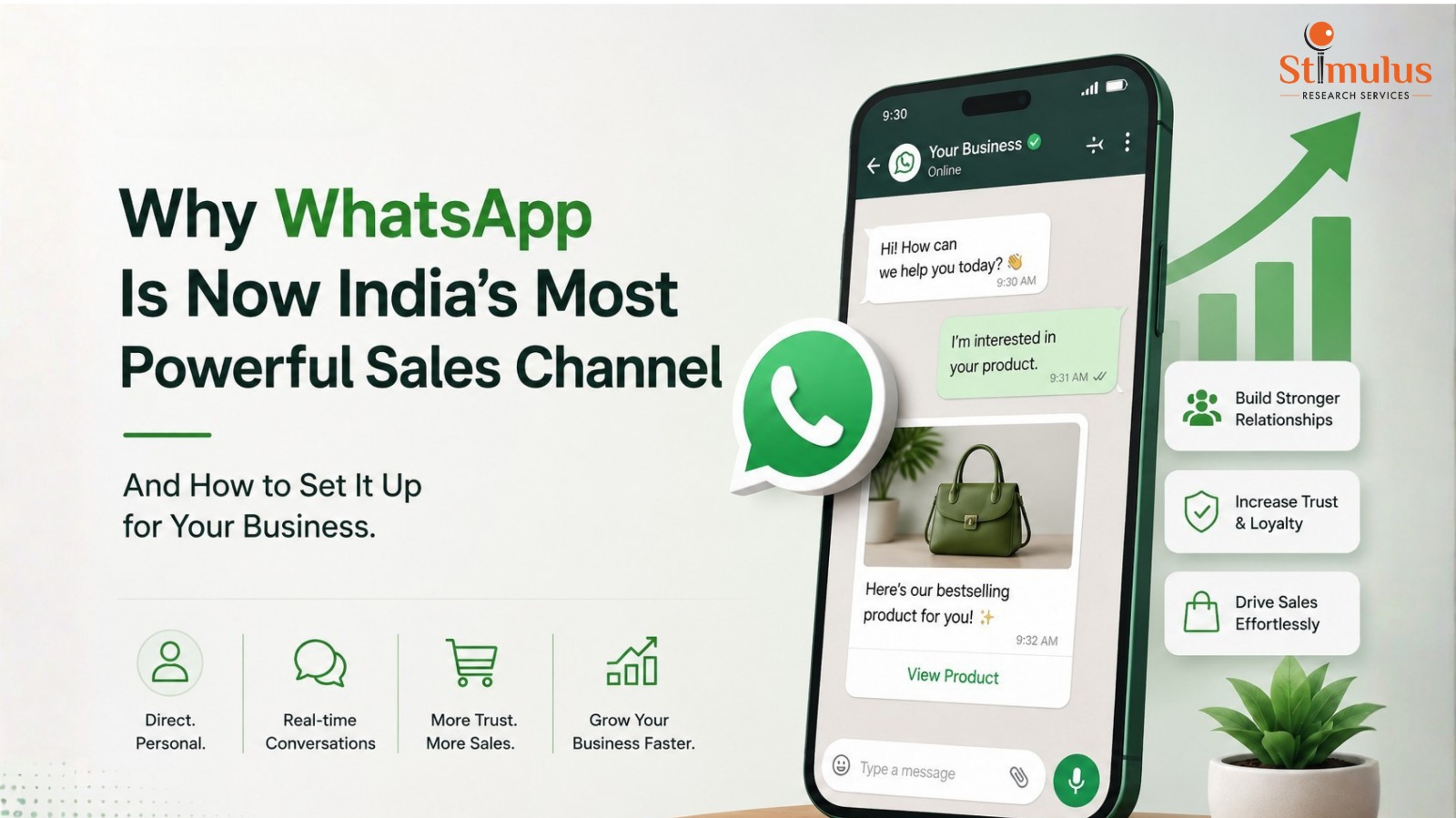
Your customers are on WhatsApp right now.
They are not checking email. They are not scrolling your website. They opened WhatsApp and they will open it again 23 more times before the day is over.
For Indian businesses, this is not a social media trend. It is a structural shift in how buying decisions happen. And the brands that understand this early are quietly building sales channels that their competitors have not even noticed yet.
| 500 Million+ Indians use WhatsApp every single day more than any other country in the world Source: Wapikit, 2025 |
WhatsApp is no longer just a messaging app. In India, it has become a commerce platform where customers browse catalogues, ask questions, make payments, and track orders, all without leaving a single chat window.
This guide covers why WhatsApp has become India’s most powerful sales channel, what the numbers actually show, and a practical setup process your business can follow today.
Why WhatsApp Outperforms Every Other Sales Channel in India
Most businesses in India still treat WhatsApp as a customer support tool, a place to answer complaints and share order updates. That thinking is costing them revenue.
The data tells a very different story.
| 98% WhatsApp message open rate compared to 15–25% for email and under 5% for most social media posts Source: EIQ Research / AiSensy, 2025 |
That number is not a rounding error. It means when you send a message on WhatsApp, nearly every recipient reads it within minutes. No algorithm filtering. No promotions tab. No spam folder.
| 18–25% WhatsApp conversion rate nearly three times higher than email marketing averages of 6–7% Source: BotMode / ElectroIQ, 2025 |
Beyond open rates, the trust factor is significant. According to research, nearly 67% of Indian consumers report higher trust in businesses they can reach directly through WhatsApp. That trust translates directly into purchase confidence and purchase confidence translates into revenue.
| Real Example A Noida-based skincare brand approached Stimulus after spending heavily on Meta ads with disappointing conversion rates. After setting up a WhatsApp Business catalogue, adding a Click-to-WhatsApp button on their Instagram ads, and building an abandoned cart recovery flow, their cost per acquisition dropped by 38% in 45 days. The customers converting through WhatsApp had an average order value 22% higher than those converting through their website because the conversation built trust before the purchase. |
The 4 WhatsApp Features Indian Businesses Are Not Using — But Should Be
WhatsApp Business offers significantly more than most Indian SMEs realise. Here are the four features that drive the highest commercial impact.
1. WhatsApp Catalogue — Your Storefront Inside a Chat
The WhatsApp Business Catalogue allows you to list products with images, descriptions, prices, and links accessible directly inside a WhatsApp conversation. Customers can browse, ask questions, and place orders without ever visiting your website.
For Indian SMEs in fashion, food, wellness, and home products, this removes the single biggest friction point: sending customers away from WhatsApp to complete a purchase they were already ready to make.
2. Click-to-WhatsApp Ads — The Highest-ROI Ad Format in India Right Now
Click-to-WhatsApp ads run on Meta (Facebook and Instagram) but land directly in a WhatsApp conversation instead of a website. The customer clicks the ad, a chat opens, and your business is already in conversation with a warm lead.
Brands using this format report 3–5x higher conversion rates compared to ads that send traffic to a landing page because the barrier to engagement collapses from “visit a website and fill a form” to “send one message.”
3. WhatsApp Automation and Broadcast — Scale Without Losing the Personal Feel
WhatsApp automation allows businesses to send personalized messages at scale abandoned cart reminders, order confirmations, restock alerts, loyalty offers triggered by customer behaviour, not manual effort.
According to BotMode research, D2C brands using WhatsApp automation experience 15–30% revenue uplift within the first 60 days. That is not from increasing ad spend. That is from recovering revenue that was already being lost.
4. WhatsApp Pay and UPI Integration — Remove the Last Step Between Interest and Purchase
WhatsApp Pay, now widely available in India, allows customers to complete UPI payments without leaving the chat. A customer who has been browsing your catalogue, asking questions, and building trust can pay in two taps without navigating to a separate checkout page.
That single friction reduction has a measurable impact on conversion rates, particularly for first-time buyers who have not yet established trust with your brand.
How to Set Up WhatsApp as a Sales Channel: A Step-by-Step Process
This is the practical part. Following these steps in order skipping ahead typically creates technical issues that are expensive to fix later.
- Step 1: Download and set up WhatsApp Business (free) or apply for the WhatsApp Business API if your volume exceeds 1,000 messages per month
- Step 2: Complete your business profile name, category, description, website, address, and business hours. Incomplete profiles reduce customer trust before the first message is sent
- Step 3: Build your product catalogue and upload products with clear images, honest descriptions, and current prices. Treat each listing with the same care as a product page on your website
- Step 4: Set up your Quick Replies and automated greeting messages a customer who messages at 11pm and gets a helpful instant response is far more likely to buy than one who waits until morning
- Step 5: Add a Click-to-WhatsApp button to your website, Instagram bio, Google Business Profile, and all paid ads every traffic source should have a WhatsApp path
- Step 6: Build your first automation flow starting with abandoned cart recovery. A simple two-message sequence sent 1 hour and 24 hours after cart abandonment can recover 15–25% of lost sales
- Step 7: Collect explicit opt-ins before broadcasting Meta’s policy requires customer consent before you send outbound marketing messages. Build opt-in collection at checkout, post-purchase, and on your website
| The brands that fail at WhatsApp commerce treat it like email broadcast — bulk messages sent to everyone. The brands that win treat it like a 1:1 conversation at scale. The technology handles the scale. The strategy maintains the personal feel. — Stimulus Research Services, Noida |
Related Reading from Stimulus
Use these internal links when publishing in Shopify they improve SEO authority and keep readers engaged with your content.
| Related Topic | Internal Link Anchor |
|---|---|
| Shopify Website Development in India | Link to: /blogs/news/shopify-website-development-india-noida |
| Digital Marketing for D2C Brands India | Link to: /blogs/news/digital-marketing-d2c-india |
| Social Media Marketing Strategy India | Link to: /blogs/news/social-media-marketing-india |
| SEO for Small Business India | Link to: /blogs/news/seo-small-business-india |
| Meta Ads Strategy for Indian Brands | Link to: /blogs/news/meta-ads-strategy-india |
Frequently Asked Questions
Is WhatsApp Business free for Indian businesses?
WhatsApp Business (the app) is completely free to download and use for small businesses. The WhatsApp Business API, which enables automation, broadcasts, and integration with CRM tools, involves conversation-based fees charged by Meta typically between 70 paise and ₹1.20 per conversation depending on the category.
How is WhatsApp different from email marketing for Indian businesses?
WhatsApp achieves a 98% open rate compared to 15–25% for email in India. More importantly, WhatsApp conversations happen in real time. Customers can ask questions and get answers instantly, which significantly increases purchase confidence and conversion rates.
What types of businesses in India benefit most from WhatsApp commerce?
D2C brands, retailers, real estate businesses, educational institutions, healthcare providers, and any business that currently relies on phone calls or manual follow-ups to convert leads. Essentially, any business where trust and conversation play a role in the buying decision.
Can I run WhatsApp ads in India through Meta Ads Manager?
Yes. Click-to-WhatsApp ads can be created directly through Meta Ads Manager on Facebook and Instagram. The ad appears in a user’s feed and, when clicked, opens a WhatsApp conversation with your business instead of directing them to a website.
How does Stimulus Research Services help businesses set up WhatsApp marketing?
Stimulus Research Services provides end-to-end WhatsApp commerce setup from Business API access and catalogue building to automation flows, Click-to-WhatsApp ad campaigns, and performance tracking. Our team is based in Noida and serves brands across India, UAE, and international markets.
Conclusion: WhatsApp Is Where Your Customers Already Are
The single most important insight from every WhatsApp marketing study is the same: Indian consumers have already normalised making purchase decisions inside WhatsApp chats.
They are comfortable browsing catalogues, asking questions, receiving payment links, and completing orders all without leaving the app. The behaviour is there. The question is whether your business is set up to meet them where they are.
The brands building WhatsApp sales channels today are not doing something experimental. They are meeting their customers in the environment those customers already prefer and converting that preference into a significant competitive advantage.
| At Stimulus Research Services, we help businesses across India set up WhatsApp as a fully integrated sales channel from catalogue setup and automation to Click-to-WhatsApp ad strategy and performance reporting. If your business is still treating WhatsApp as a customer support inbox, it is time to change that. Visit stimulusservices.com or call +91 76692 98911 to speak with our team in Noida. |